How does this pool alkalinity calculator work?
It works in both directions: enter your reading and it returns either the pounds of baking soda needed to raise total alkalinity, or the muriatic acid needed to bring it back down. Alkalinity is the carbonate buffer that resists pH change — measured in ppm CaCO₃, it is what keeps your pH steady through the swim season.
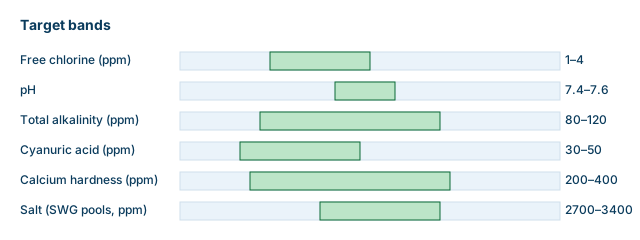
The healthy band is 80–120 ppm. Per the Pool & Hot Tub Alliance handbook, pools running below 60 see pH swing 0.4 units in a single day, and the National Swimming Pool Foundation traces 78% of pH complaints to a reading outside that band.
How much baking soda to raise alkalinity per 10,000 gallons?
The dose is 1.5 lb of baking soda per 10 ppm TA raise per 10,000 gallons — so a 20-point raise needs 3.0 lb at 10,000 gallons, 6.0 lb at 20,000, and 9.0 lb at 30,000.
| TA raise | 10,000 gal — baking soda | 20,000 gal — baking soda | 30,000 gal — baking soda |
|---|---|---|---|
| 10 ppm | 1.5 lb | 3.0 lb | 4.5 lb |
| 20 ppm | 3.0 lb | 6.0 lb | 9.0 lb |
| 30 ppm | 4.5 lb | 9.0 lb | 13.5 lb |
| 40 ppm | 6.0 lb | 12.0 lb | 18.0 lb |
How to add baking soda to your pool
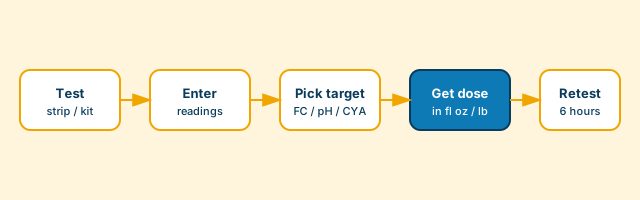
Once the calculator gives you a dose, add the baking soda in three steps. First, run the pump so the water is circulating. Second, broadcast the baking soda across the deep end in a wide arc instead of dumping it in one spot — a concentrated pile can cloud the water and settle on the floor before it dissolves. Third, leave the pump running for 6–8 hours and retest before adding anything else. Baking soda dissolves readily in pool water, so there is no need to pre-dissolve it in a bucket the way you would with calcium chloride.
For a large raise — more than about 30 points — split the dose in half and add it over two days. A single oversized dose can briefly nudge pH up and leave a cloudy haze for a day. Splitting it keeps the water clear and lets you confirm the TA is trending toward target before you commit the rest.
What raises TA versus what lowers TA?
- Sodium bicarbonate (baking soda) raises TA with minimal pH change; the workhorse for low TA.
- Soda ash (sodium carbonate) raises both pH and TA; useful when both are low.
- Muriatic acid (31.45%) lowers both pH and TA together; about 2.5 fl oz drops TA ~1 ppm in 10,000 gal (roughly 25 fl oz per 10 ppm).
- Dry acid (sodium bisulfate) lowers both at the same ratio, granular form.
Baking soda vs. soda ash and other pool chemicals
Baking soda is not the only chemical that moves alkalinity, and reaching for the wrong one is the most common dosing mistake. Use this quick guide to match the chemical to the reading:
- Low TA, pH is fine → baking soda. It lifts total alkalinity with almost no effect on pH, which is exactly what the calculator above doses.
- Low TA and low pH → soda ash (sodium carbonate) raises both at once, so you make one adjustment instead of two.
- High TA → muriatic acid or dry acid (sodium bisulfate) brings it down. Both also pull pH lower, so aerate the water afterward to nudge pH back up.
All four are common pool chemicals sold at any pool store or hardware aisle. "Pool grade" baking soda and the box in your kitchen are the same stuff — with pool products you are usually paying for a bigger bag, not a purer chemical.
Where alkalinity fits in your pool's water balance
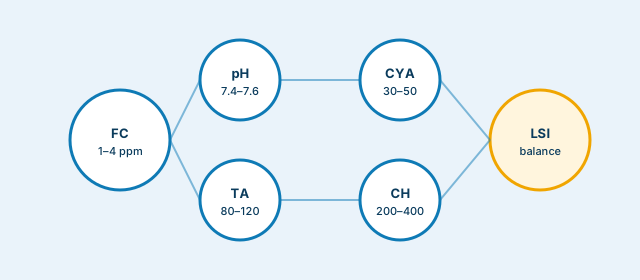
Total alkalinity is one of five readings that decide whether your swimming pool water is balanced. They interact, so it helps to see the whole picture before you reach for the baking soda:
- pH (7.4–7.6) — the master dial for swimmer comfort and sanitizer strength. Alkalinity is the buffer that keeps it from drifting, so set TA first and pH gets much easier to hold. Fine-tune it with the pH calculator.
- Total alkalinity (80–120 ppm) — the buffer this page doses with baking soda.
- Free chlorine (1–4 ppm) — the sanitizer that kills bacteria and keeps algae from blooming. Balanced TA and pH let it work at a fraction of the dose; size it with the chlorine calculator.
- Calcium hardness (200–400 ppm) — too low and the water etches plaster, too high and it scales the heater. Check it with the calcium hardness calculator.
- Cyanuric acid (30–50 ppm) — the stabilizer that shields chlorine from sunlight.
When all five sit inside their recommended ranges the water is balanced: clear, comfortable to swim in, gentle on equipment, and slow to grow algae. Alkalinity is the one to set first because it steadies everything downstream. The ideal ranges guide lists every target in one table, and the water balance walkthrough shows the full sequence step by step.
Why does TA drift over time?
TA falls naturally as acid is added and as CO₂ off-gases through aeration — typically 5–15 ppm a month. The Water Quality & Health Council finds that pools held near 80 stay stable longer than those held at 120; the buffer band is identical, but the lower starting point drifts less.
Should I adjust pH or TA first?
Adjust TA first — the calculator defaults to that order. TA changes drag pH downstream, but pH changes barely move TA: CDC pool guidance puts a 20-point TA raise at a 0.1–0.2 pH shift, while a 0.2 pH change moves TA only 2–3 points. Reach for the pH calculator once TA is in band.