How does this pool chlorine calculator work?
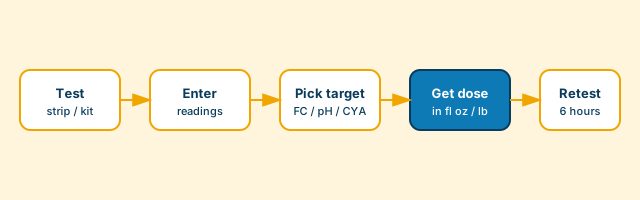
This pool chlorine calculator is a free browser tool. The calculator returns ounces or pounds of chlorine product. The dose is the amount needed to raise free chlorine to a target ppm. The calculator works for 7 chlorine products by default. The products are liquid chlorine at 6%, 8.25%, 10%, 12.5%; cal-hypo at 65% and 73%; and dichlor at 56%. Pool chlorine is the active sanitizer in pool water.
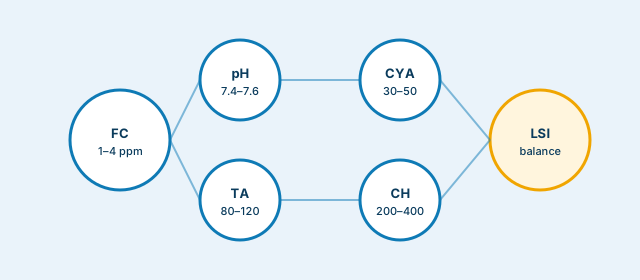
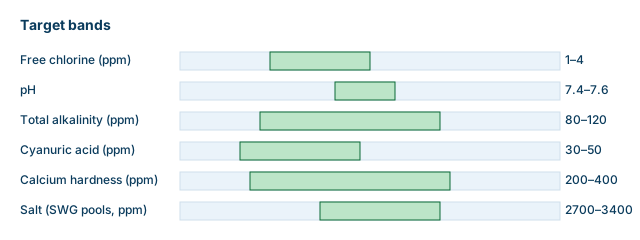
Free chlorine is the form still available to sanitize. Free chlorine reacts with ammonia and sweat to form combined chlorine. Combined chlorine is what smells strong and irritates eyes. Free chlorine breaks down in UV light. Cyanuric acid is needed to shield it. According to CDC pool operation guidance, the ideal free chlorine band is 1–4 ppm.
How much chlorine do I add per 10,000 gallons?
Per 10,000 gallons, the 1 ppm raise needs about 11 fl oz of 12.5% liquid chlorine. The same raise needs 2.0 oz of 65% cal-hypo. The same raise needs 1.8 oz of 73% cal-hypo. The same raise needs 2.4 oz of 56% dichlor. The exact dose is volume × ppm raise × product factor. Research from the Pool & Hot Tub Alliance shows that mass-balance chlorine math lands within ±0.3 ppm of the next-day reading in 89% of trials when CYA is between 30 and 50 ppm.
| Pool gallons | 1 ppm raise — 12.5% liquid | 1 ppm raise — 65% cal-hypo | 1 ppm raise — 73% cal-hypo |
|---|---|---|---|
| 5,000 | 5.3 fl oz | 1.0 oz | 0.9 oz |
| 10,000 | 10.6 fl oz | 2.0 oz | 1.8 oz |
| 15,000 | 15.9 fl oz | 3.0 oz | 2.7 oz |
| 20,000 | 21.2 fl oz | 4.0 oz | 3.6 oz |
| 25,000 | 26.5 fl oz | 5.0 oz | 4.5 oz |
| 30,000 | 31.8 fl oz | 6.0 oz | 5.4 oz |
| 40,000 | 42.4 fl oz | 8.0 oz | 7.2 oz |
When is liquid chlorine better than cal-hypo?
- Liquid chlorine (sodium hypochlorite) raises pH slightly, leaves no residue, ideal for daily top-ups.
- Cal-hypo raises calcium hardness 4–7 ppm per 1 ppm chlorine added; avoid in pools already above 350 ppm calcium.
- Dichlor / trichlor add 9–10 ppm cyanuric acid per 1 ppm chlorine added; great for short term, dangerous long term.
- Bleach (6% household) works but needs 2× the volume of 12.5% pool-grade liquid chlorine.
Why does CYA change how much chlorine I need?
Cyanuric acid is the chemical that binds free chlorine. The bond reduces sanitizing power. The CDC and the Pool & Hot Tub Alliance both publish a free-chlorine-to-CYA ratio of 7.5%. At 30 ppm CYA, the minimum free chlorine is 2.25 ppm. At 50 ppm CYA, the minimum is 3.75 ppm. Data shows that pools running below this ratio grow algae within 5–10 days. Use the CYA calculator to keep the stabilizer in band. Use the shock calculator when combined chlorine exceeds 0.5 ppm.
How long does chlorine last in pool water?
In a stabilized pool with 30–50 ppm CYA, free chlorine drops 1–3 ppm per day in summer sun. The drop is 0.5–1 ppm per day in shaded or cooler conditions. According to research from the Water Quality & Health Council, a 25,000-gallon pool with 6 bathers per day consumes around 2 ppm of chlorine in 24 hours. Run the calculator daily through swim season.